
Every process you move onto the engine saves working time and makes the next one easier. We build the workflows for you or enable your team to develop them further.

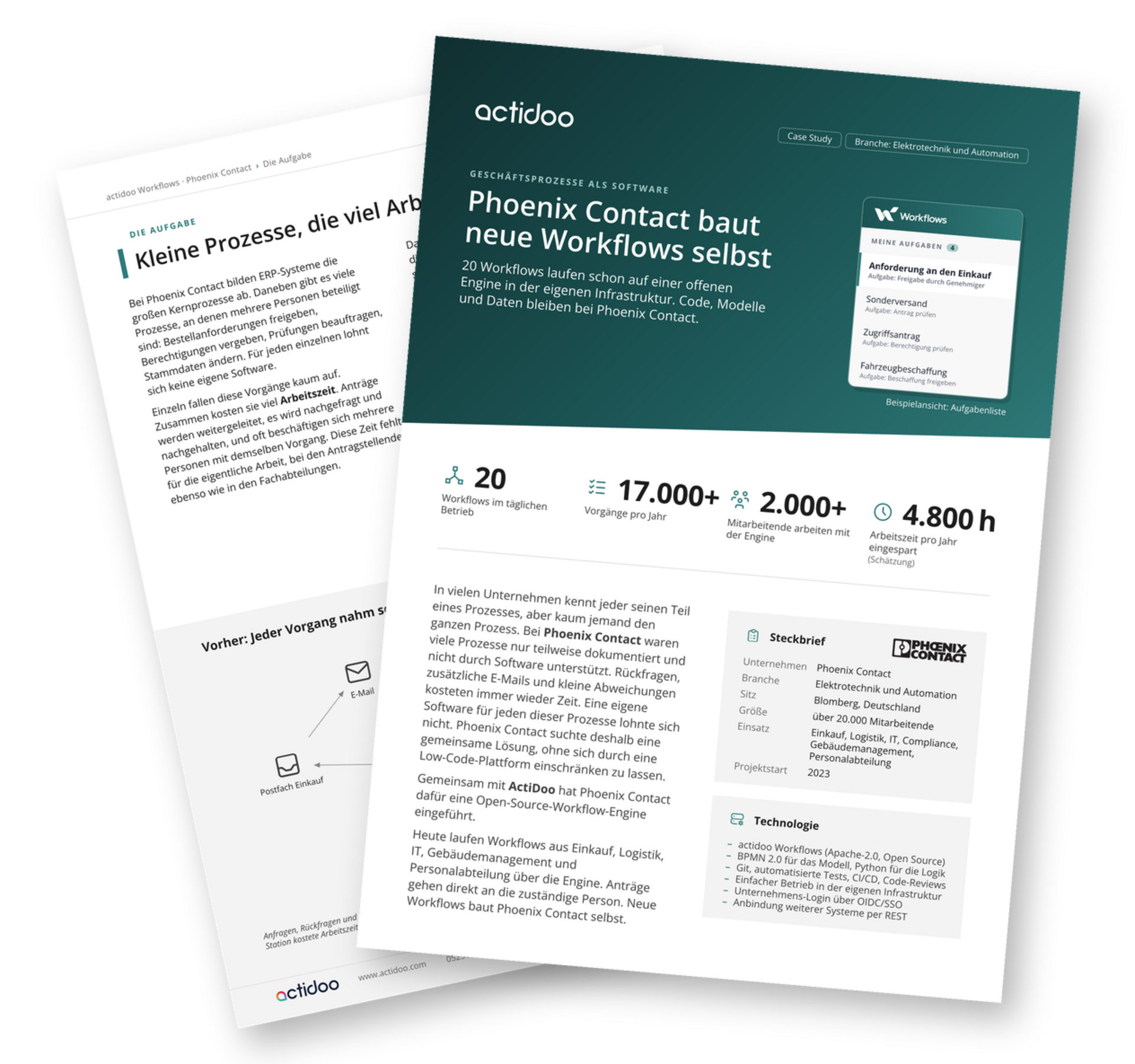
Figures from the deployment at Phoenix Contact, as of September 2026. The time saved is an extrapolation from a rough estimate per completed case.
Every organization runs dozens of processes in which someone requests or reports something and others review and approve it. Each one looks different. A purchase approval has little in common with a damage report. Introducing and running separate software for each of them would take a lot of effort. Putting them on one shared foundation saves time every day.
Requests are forwarded and chased, often by several people.
An audit asks who approved what and when. That is hard to piece together from email threads.
What works in one department should run in others. Or the number of cases keeps growing.
A platform is being discontinued, license costs rise, or a low-code solution hits its limits.
Order and procurement approvals, onboarding new suppliers, contract approvals.
Requests for access and permissions, on- and offboarding, service requests.
Hiring and onboarding, absence and business travel requests, travel expenses.
Invoice and payment approvals, budget and investment requests.
Internal requests and approvals, co-signing procedures, procurement.
Change requests, deviation approvals, damage reports and repair approvals.
Ordering mandatory inspections, fault reports, safety briefings.
Risk assessments, whistleblower cases, GDPR access and deletion requests.
Loan applications, claims handling, underwriting approvals.
If you don't have a team of your own for this, we model, build and run your workflows together with your departments. You commission one process at a time.
If you want to do it yourself, we help you set up a small internal team (center of excellence) that builds workflows on its own. Often we build the first workflows and your team gradually takes over.
The engine is open source, but you are not on your own with it. The team that develops it stays with you after the first workflow.
From the pilot to organization-wide use.
After the free initial meeting and a process audit, the first workflow goes live as a pilot.
More departments join and reuse the existing building blocks and integrations.
Each additional process runs on the same engine and costs less as a result. There are no license fees per process.
Example: an access request as a BPMN diagram, with two tasks for people and one automatic step.
You draw the process as a diagram in the open BPMN 2.0 standard, and the forms in the same modeler's form editor.
Wherever something is calculated or another system is called, you write a short Python function. There is a Python library for almost every system.
The workflows live in a Python package in your repository. Your usual tools apply: version control, code review, tests and CI/CD.
Input forms that adapt to each step and validate entries.
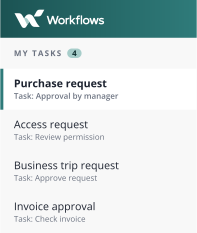
Everyone sees their open tasks in one place. Urgent and overdue tasks are marked.
Built in, so approvals keep moving while people are away.
Sign-in through your existing login (OIDC/SSO), permissions via roles.
For each task you can set when it counts as urgent or overdue. Deadlines with a follow-up step are part of the process.
Every step is logged and can be traced later.
Do I need developers to build workflows?
Can we connect our existing systems?
How do we move away from Excel or our current tool?
Where does the engine run, and where is the data?
Who provides security updates if we run it ourselves?
How is this different from a low-code platform?
How does the introduction work, and what does it cost?

Source code, documentation and example workflows are openly available on GitHub.